
How to Start Email Marketing for Your Small Business
Most small businesses underinvest in email marketing – and that’s often because they are not sure where to begin! Email marketing feels deceptively simple until you sit down to actually figure out how it works and what to do to make it effective.
We have created this guide to give you a practical overview and a simple approach to email marketing that works whether you are pre-launch, early-stage, or in a growth stage.

Why Email Marketing Still Matters for Small Businesses
Every so often some (improvised) marketers cry the death of email marketing on social media. This opinion couldn’t be farther from reality. In fact, email marketing has been the most consistent tool for the past couple of decades, with numbers increasing year on year.
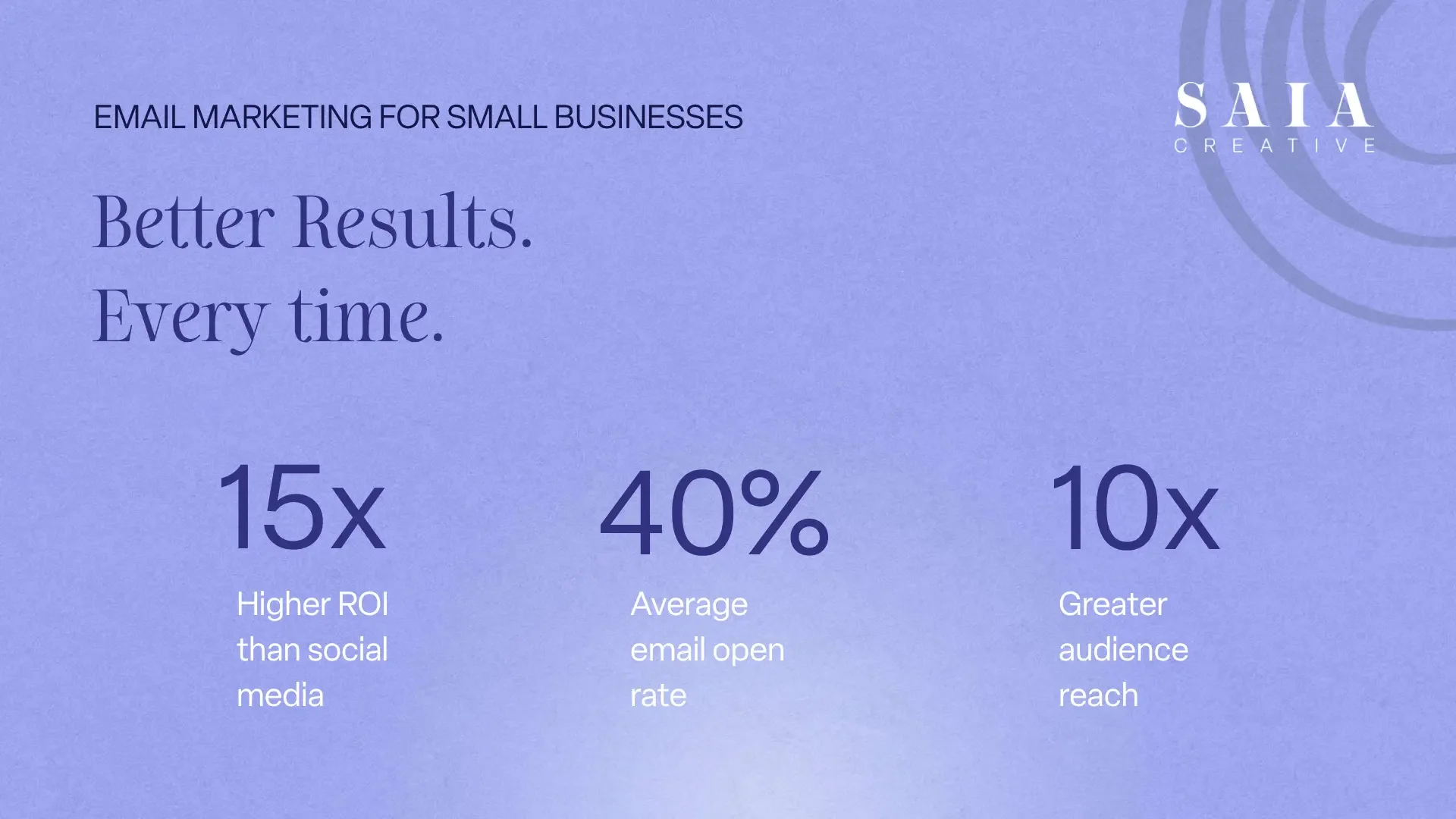
Litmus and Hubspot reports from recent years consistently show that email is one of the strongest marketing and sales tools for businesses, generating 10x-15x higher ROI than social media.
Email has better - and more stable - engagement and reach too; a good average open rate (across all industries) is about 36-43%, with a typical click-through rate around 3%. In comparison, organic social media reach is often 2-4% of followers. So a brand can reach 10× more of its audience with email than social media content.
Last but not least, social media is unreliable by design. Platforms limit organic visibility to push paid spend, algorithm updates can halve your engagement overnight and accounts can get hacked, blocked or shut down, which creates a bigger problem for your business if that’s what you’re relying on.
Your email list, by contrast, is an audience you own and you have more control over who sees what. That ownership alone has incredible value for your business. In fact, when someone subscribes to your emails, they are showcasing a meaningful level of interest - far stronger than a passive follow - which often translates into higher conversion rates and improved client retention over time.
For small businesses in particular, email is a great tool that ultimately gives you more control when it comes to lead-gen, launches, client retention and clients lifecycles.
What a Simple Email Marketing Strategy Looks Like
Define the role and purpose of your email marketing
Before you build anything, decide what you want email to do for your business. Here are some of the questions you might want to ask yourself as you get started:
- Do you want to leverage email marketing to drive repeat purchases?
- Are you looking to nurture enquiries that did not convert the first time?
- Do you just want to stay front-of-mind with past clients?
- Are you planning to build a database you can use for new launches?
- Is your main goal to increase your authority and credibility to people who showed interest in your brand?
Your answers will eventually shape your content, your frequency, your format, even your list-building approach or platform.
Without a clear purpose, your email marketing will not have the same impact and you will risk wasting time and money on something that just won’t work. Reach shows you how many people actually saw the content and whether it’s getting distribution and how e.g. existing followers vs non-followers.
Choose an email marketing platform that fits your needs
Once you know what you’re going to do with your email, it’s the time to choose the right tool! For most small businesses, platforms like Mailchimp, Kit (formerly ConvertKit), MailerLite Brevo, Omnisend or Klaviyo will cover everything you need.
Some of these platforms will better cater to service-led businesses, while others (Omnisend, Klaviyo) are great if you focus on products. Most of them also feature a built-in CRM option, but all can be easily integrated with other CRM platforms.
Cost will also vary, often depending on the amount of subscribers and/or volume of emails sent monthly. For a small business wanting to start email marketing, a platform could cost as little as £15-£30/month. If you already have a database with over 2,000-3,000 contacts the cost could quickly rise to £50-£150/month, depending on the platform and its features.
As you can see, the options are many and the best way to pick is to look at your individual needs, budget, and current use, before even looking at features, as this will inform you about what functionalities are most relevant to your business.
Build and nurture a healthy email list from day one
A small, targeted, engaged list consistently outperforms a large, irrelevant one. Focus your list-building on attracting people who have a genuine reason to hear from you, who might be leads and who can turn into clients.
How do you build an email list for your business?
There are many different tactics you can use, from simple lead magnets (freebies) relevant to your audience, to optimised opt-in forms on your highest-traffic web pages, to post-enquiry email capture automations, to content upgrades (sharing bonus content or tools within a free resource that are only unlocked once someone signs up), or tapping into the audience of a strategic partnership. The list could go on - but of course, you don’t need to do everything at once! Just test out a couple of these at the time, assess results and evaluate what’s working best, so you can slowly identify the strongest funnels for your needs.
Plan your sending schedule - and stick to it!
Consistency matters more than frequency: a fortnightly email you actually send will outperform a weekly one you abandon after three weeks. So make sure to choose a schedule that fits your capacity right now, and you can always scale up as your confidence grows or as your resources are enough to outsource email marketing to a marketing agency.
Small Business Email Marketing: What to Send
“What kind of content should I share in my email marketing?”
This is probably the question we get asked the most!
In reality, the answer needs to be fully tailored to you, your business goals and your audience, but there are definitely things any business can - and should - share in their email marketing:
Helpful insights and authority-building content
Think of content that helps your audience solve a problem, make a better decision, or understand something relevant to your services. This will help them get more and more familiar with you and - from a sales-psychology perspective - it will build trust and make them more likely to say yes when you offer your services.
You can also leverage your emails to further build your brand’s credibility and establish authority within your industry. You can share relevant case studies, showcase your expert opinion to tackle a specific industry-wide concern or write thought-leadership articles that help your brand differentiate from competitors and create engagement.
Sky’s the limit when it comes to content, as long as you are sharing topics that are aligned with your core messaging and positioning and writing in your brand voice.
Launches and service updates
Email is one of the most effective channels for launches and updates. A well-crafted email sequence to announce the launch of a new service to an engaged (qualitative) list will immediately generate revenue.
So while it’s great to focus on giving value and sharing expert content, you’ll want to make email marketing an integral part of your sales strategy and share regular updates (or simple overviews) about the services your business offers.
Offers and promotions
You’d be surprised at how many small businesses feel awkward about sending offers via email. But trust us when we say - promotional emails work when they are relevant, well-timed, and do not dominate your entire email schedule!
Consider creating exclusive offers and promotions for list subscribers or leverage seasonality to come up with promotions that can engage both existing and past clients.

Common Email Marketing Mistakes Small Businesses Make
At this point, you might be very excited to get going with your email marketing or to create a new strategy for that mailing list you’ve been sitting on… but before you do, here are some of the most common mistakes small businesses make:
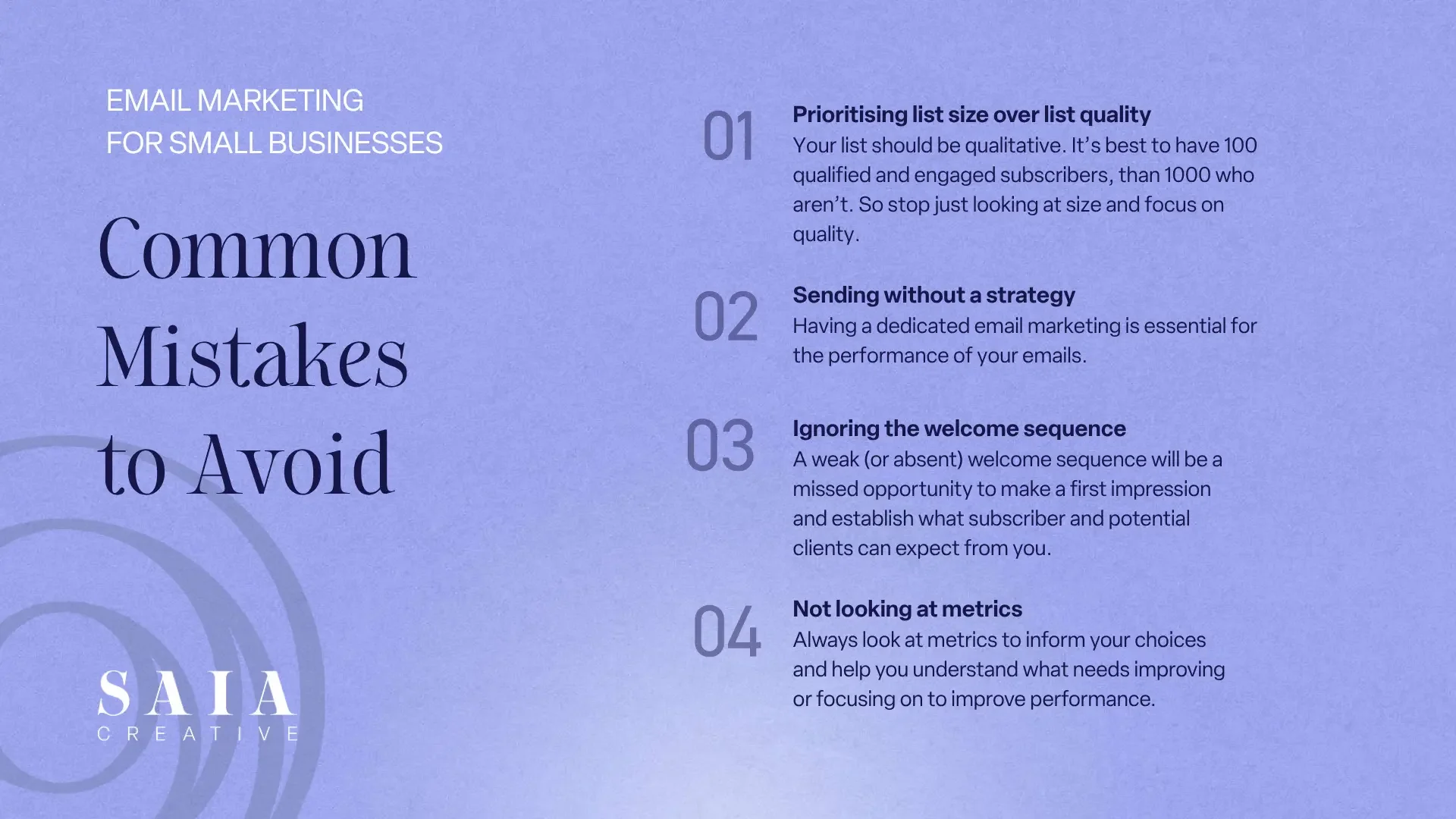
Visual: Minimal typographic list highlighting common email marketing mistakes (clean, editorial style).
1.Prioritising list size over list quality
A subscriber who joined for a discount and has no genuine interest in your business is not an asset, they just drag down your engagement metrics and cost you money.
2.Sending without a strategy
Reactive, ad hoc emails rarely amount to good results, so ensure you have a good email strategy that’s purposeful, targeted and aligned with your overall digital marketing strategy.
3.Ignoring the welcome sequence
The moment someone subscribes is your first chance to make an impression, set the tone for what they can expect from you and start building trust. A weak (or absent) welcome email will just waste this opportunity, so make sure to pay attention to how you welcome and nurture new subscribers.
4.Not looking at metrics
Open rates and click rates are useful indicators and they can inform your choices when it comes to more content, new services, clients’ behaviours and preferences, so it’s essential to look at this data and use it wisely. Depending on the tech stack you use, email marketing can also provide great insights into conversions, repeat purchase rate, enquiries generated and other revenue-related metrics.
Making Email Marketing Part of Your Long-Term Growth Strategy
Email marketing is not about one-off campaigns and random newsletters. The businesses that see the strongest returns from email are the ones that treat their list as a long-term asset, in connection to a wider business and marketing strategy. They build their email database with intention, they nurture it with consistency and they use it strategically at every stage of growth.
So if you want to make email marketing part of your growth strategy, remember to start with a clear goal, a qualitative list-building approach, a strong welcome email, and a realistic email marketing plan. Get those right and once you feel more confident and you’re seeing results, then you can look at automation, segmentation, and more sophisticated sequences as your business scales.
The businesses that start this simply, stay consistent, and refine as they go are the ones who find, twelve months later, that email has become one of their most reliable and valuable platforms for lead-gen and conversion.
Make Email Marketing
Work for Your Business
Email marketing is one the core specialties of the Saia Creative team - so if you want to further explore how to integrate emails in your business or you are looking for a consultant to help you improve your current email marketing efforts, we are the right people for the job!
FAQs
How do you start email marketing for a small business?
Start by defining what you want email to actually do for your business. Whether that is generating leads, nurturing enquiries that did not convert, retaining existing clients, or supporting a launch, your goal shapes everything: your content, your platform, your frequency, and how you build your list. Without that clarity, email marketing rarely delivers consistent results.
What is a simple email marketing strategy?
A simple email marketing strategy has three components: a clear purpose, content that supports your business goals, and a sending schedule you can realistically maintain. Without those foundations, email becomes reactive and ad hoc, which is exactly what prevents it from building momentum over time.
How do you build an email list for a small business?
Focus on attracting people who have a genuine reason to hear from you, not just anyone willing to hand over an email address. Lead magnets, optimised opt-in forms, post-enquiry capture, and strategic partnerships are all effective tactics. A small, engaged list will consistently outperform a large, disengaged one.
What should small businesses send in their email marketing?
The most effective emails for a small business fit in three categories: helpful content that builds trust and authority, relevant updates about your services, and well-timed offers or promotions. The goal is not just to stay visible but to make your audience more likely to say yes when you put something in front of them.
How often should small businesses send marketing emails?
Consistency matters more than frequency. A fortnightly email you actually send will outperform a weekly one you abandon after a month. Start with a schedule that fits your business capacity and scale up as your confidence and resources grow.